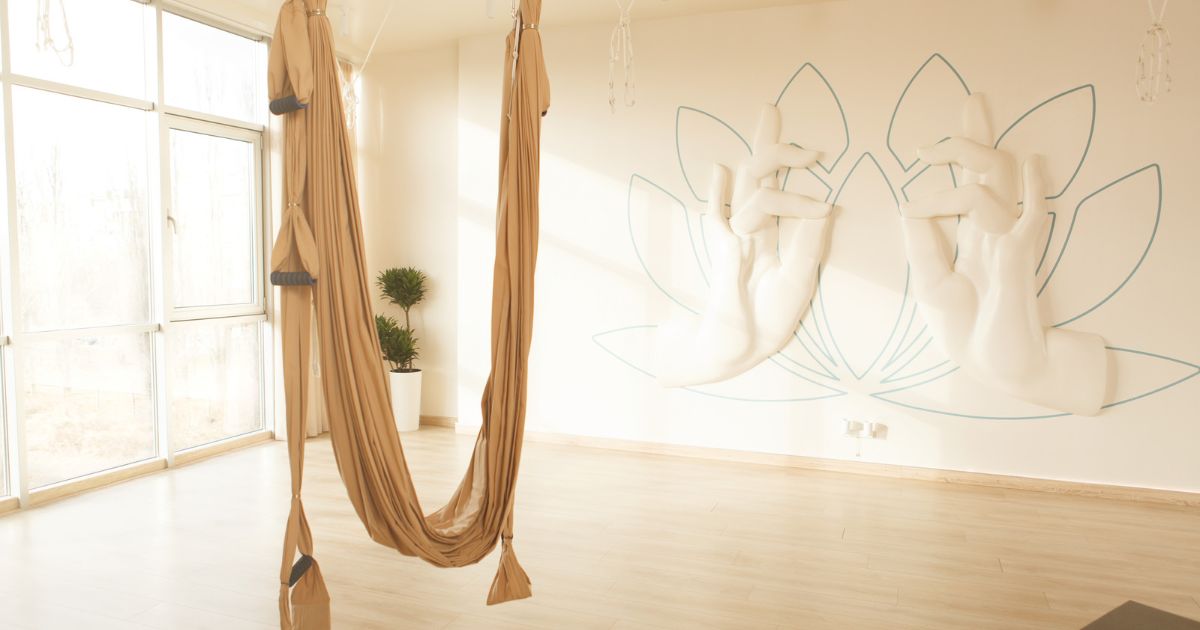
Setting up aerial yoga at home is exciting, and it’s also where people spend money on the wrong things. I’ve seen students buy a beautiful hammock and only then wonder what to hang it from, or clip it up with carabiners from a hardware store that were never meant to hold a person.
I’ve practiced aerial yoga since 2008 and taught it for years. I kept a freestanding frame in the studio where I danced and taught, and I’ve rigged swings and hammocks at home, in studios and on frames more times than I can count. This guide covers everything you need, in the order I’d buy it, with links to our detailed reviews for each piece.
What equipment do you need for aerial yoga at home?
You need an aerial hammock or yoga swing, a rated place to hang it (a freestanding stand, ceiling mounts in a solid joist or beam, or a doorway bar for gentle work), locking carabiners with a load rating, daisy-chain straps to set the height, and a mat underneath. Add fitted clothing and you’re ready.
Aerial yoga equipment checklist
Use this as your shopping list. Start with the essentials, and add the rest as your practice grows.
| Item | What it’s for | Do you need it? | Our guide |
|---|---|---|---|
| Aerial hammock or yoga swing | The fabric you practice in | Essential | Best hammocks and swings |
| A rated place to hang it | A stand, ceiling mounts or a doorway bar | Essential | Stands, ceiling hooks |
| Locking carabiners | Connecting the hammock to the mount | Essential, with a marked kN rating | Aerial rigging guide |
| Daisy chains or extension straps | Setting the hammock’s height | Usually | Extension straps |
| Crash mat | Softening a slip or fall | Strongly recommended for inversions | Crash mats |
| Yoga mat | Warm-ups and floor work | Recommended | Yoga mats for carpet |
| Fitted clothing | Protecting skin from the fabric | Essential | What to wear |
| Swivel | Letting the hammock spin | Optional | Aerial rigging guide |
| Extras | Cushion inserts, ladders, yoga wheels, books | Optional | Accessories |
Aerial hammock or yoga swing: which should you buy?
Both are often sold as “aerial yoga swings,” but they’re different tools. The right one depends on what you want to do in it.
Aerial yoga hammock
A hammock is one long, wide length of fabric, usually nylon tricot, hung from two points so it forms a soft loop. It’s what most studios use. Firetoys’ hammock, for example, is 6 m long and 2.8 m wide, in a medium-stretch fabric tied onto O-rings. You can sit in it, lie in it like a cocoon, wrap it around your hips or thighs for inversions, and use it as a sling for stretches.
Hammocks come in different amounts of stretch. Low-stretch fabric feels steadier and is easier to control. Medium stretch feels softer and bouncier. For a first home hammock, I’d pick low or medium stretch rather than anything very stretchy, which is harder to keep still in.
Best for: A first home hammock
Uplift Active Hammock (Low Stretch) Set
A low-stretch nylon tricot hammock kit rated for users up to 400 lb, with rated daisy chains and steel screw-lock carabiners in the box.
- Rated for users up to 400 lb (fabric safe load 200 kg)
- Published safe loads for the carabiners and daisy chains too
- Low-stretch 40 denier nylon tricot, 2.4 to 2.8 m wide
- Daisy chains are rated at 190 lb each, so always hang from both
- Ceiling mounts or a stand sold separately
Yoga swing or trapeze with handles
A yoga swing, sometimes called a yoga trapeze, has a fabric seat with handles at two or three heights. The Omni Gym Swing Pro, for example, has six handles at three lengths, with padded foot stirrups on the longest pair and a cushioned seat. Swings are usually firmer than hammocks, often in parachute-style fabric.
Handles make supported inversions and backbends easier to get into, which suits beginners and anyone who mainly wants to hang and stretch. What you lose is the wrapping and cocooning that a hammock allows. Swing models come and go quickly, so check that the one you want is still made, and that it lists a load rating, before you order.
Which suits you?
- Choose a hammock if you take or want to take aerial yoga classes, want to learn wraps and cocoon poses, or plan to grow your practice.
- Choose a swing if you mainly want supported inversions and stretches, like having something to hold, or practice alone at home without a teacher’s cues. Our yoga swing poses for beginners show what you can do with handles.
Our best aerial yoga hammocks and swings compares current options side by side.
Where to hang it: stand, ceiling, doorway or beam
This is the most important decision on the list, because everything else hangs from it. Whatever you choose, check its working load limit, the most it’s rated to hold in use. Our guide to aerial yoga weight limits explains how to read those ratings.
A freestanding aerial stand
A stand needs no drilling, so it’s the answer if you rent, aren’t sure about your ceiling, or want to practice outside. The trade-off is space. X-Pole’s A-Frame needs about 47 sq ft of floor at its lowest height and 95 sq ft fully extended. Omni Gym makes a 7 ft 11 in pyramid stand that fits under a standard 8 ft ceiling.

Best for: A freestanding rig for home or garden
X-Pole A-Frame
A load-tested, height-adjustable aerial rig that handles hammocks, hoops and low silks, and packs into carry bags.
- Independently load tested: 140 kg (308 lb) working load limit at 5:1
- Adjusts from 8 ft to 11.42 ft
- Carry bags, stabilization straps and weight bags included
- Large footprint at full height (95 sq ft)
- Load limit drops at taller settings
- One of the pricier stands
Compare all the frames in our best aerial yoga stands guide, or read our full review of the X-Pole A-Frame.
Ceiling mounts in a joist or beam
A pair of rated mounts fixed into a solid joist or beam gives you a permanent point that takes up no floor space. The mount is rarely the weak point. The timber is. Wood can never be given a guaranteed rating because it varies, so have a structural engineer or experienced aerial rigger check it, and have the mounts fitted properly.1 X-Pole, for example, says its Arize hammock mount must be installed by a professional tradesperson.
Avoid cheap screw-in ceiling hooks. They aren’t rated for human loads,1 and even ordinary garden hammocks have been recalled because their hooks failed.2 See our guide to ceiling hooks and our step-by-step guide to installing an aerial yoga hammock at home.
A doorway bar
A screw-in pull-up bar in a solid wooden door frame is the cheapest way to hang a swing. Most are listed at around 220 lb, and the door frame is only as strong as its construction. Keep to gentle, supported poses, never swing, and read our guide to using a yoga swing in a door frame first.
An exposed beam or a tree
A sound exposed beam can work without any fixings: wrap a rated strap around it and clip on with locking carabiners. Trees are riskier, because branches can hide rot and cracks you can’t see. I’d only use one for an occasional outdoor session, after someone qualified has looked at it.
How much ceiling height do you need?
From years of setting up hammocks, I find a hanging point around 8 to 9 ft high gives most adults enough room to invert with their head clear of the floor. Lower than that, you can still practice, but you’ll shorten the hammock and stick to seated and supported poses. Leave clear space all around, too, so you can step out of the hammock without hitting furniture.
Rigging hardware: carabiners, daisy chains and swivels
The small metal parts between your hammock and your mount are what most beginners skimp on. Don’t. Each one should be made for aerial or climbing use and marked with a load rating.

- Carabiners: steel, locking (screw-gate or auto-locking), with a kN rating stamped on the spine. Check the ones that come with your kit. Some swing kits ship with light quick-clips rated far below the swing itself.
- Daisy chains or extension straps: looped straps that let you raise or lower the hammock without retying it. Choose ones sold for aerial yoga with a stated rating. Our extension straps guide compares them.
- Swivel: lets the hammock spin. It’s optional, needs a few extra inches of height, and must be a rated rigging swivel, not a decorative one. A single-point hammock with a swivel may also need a rigging plate.
Our aerial rigging guide explains each piece, including swivels, rigging plates and figure-8s.
Mats: what goes under your hammock
You’ll want two kinds of mat, and they do different jobs. A yoga mat is for warm-ups, cool-downs and floor poses. A crash mat is for landing on if you slip.
Here’s the mistake I see most: a thin folding gym mat sold as a “crash mat.” A 2 in mat is great for kneeling and floor work, but it won’t do much if you come out of an inversion head first. Firetoys recommends a crash mat at least 20 cm (8 in) deep under any rigging point.1 Our crash mat guide separates the mats that protect you from the ones that just pad the floor.
Best for: Proper fall protection under inversions
Firetoys F-200 Folding Crash Mat
A 20 cm, dual-density aerial landing mat from a circus supplier, for when you need real fall protection.
- 20 cm thick, with low- and medium-density foam layers
- Folds in half, with hook-and-loop tabs
- Flame-retardant cover
- Heavy, at about 22 kg
- Too soft for standing floor work
- Ships from the UK
If you practice on carpet, a thick, grippy yoga mat stops you sliding during warm-ups. See our best yoga mats for carpet.
What to wear for aerial yoga
Clothing is part of your kit, because the fabric presses and slides against your skin. These are the rules I give every new class:
- Cover your armpits and the backs of your knees. Those are where the fabric rubs most. Full-length leggings and a top with sleeves, or at least a T-shirt, save you from fabric burn.
- Wear fitted clothes. A loose top falls over your face when you invert.
- Skip zips, buttons, studs and jewelry. They snag and ladder the fabric, and rings can catch on it.
- Go barefoot, unless your teacher suggests grip socks.
Read more in our guides to aerial yoga clothing and preventing friction burns.
Useful extras
None of these are essential, but some make home practice more comfortable or help you progress:
- A cushion insert or hanging ladder for a yoga swing. Both feature in our aerial yoga accessories list.
- A good manual. Practicing at home means no teacher to cue you, so a photo-led guide helps. See our best aerial yoga books.
- A wash bag. Hammocks need washing now and then, and how you do it matters. Here’s how to wash aerial silks and hammocks.
- Other aerial apparatus, if your frame and ceiling are rated for it: aerial silks, an aerial hoop (plus hoop tape) or a bungee fitness kit.
Budget tiers: three ways to set up
You don’t have to buy everything at once. Here’s how I’d build a home set-up at three levels of spend. The safety items stay the same at every level: rated hardware and something soft underneath.
| Tier | Where to hang it | What to hang | Underneath | Best for |
|---|---|---|---|---|
| Budget | A doorway bar in a solid wooden frame, or a sound exposed beam with a rated strap | A yoga swing with handles, plus rated locking carabiners | A folding gym mat for floor work | Gentle, supported stretches and low inversions |
| Mid-range | Rated ceiling mounts, professionally fitted into a checked joist or beam, or a compact stand | A low- or medium-stretch hammock, daisy chains and locking carabiners | A thicker crash mat and a yoga mat | A full home aerial yoga practice |
| Premium | A height-adjustable A-frame, such as the X-Pole or Uplift Active rig | A hammock, plus a rated swivel if you want to spin | A 20 cm (8 in) crash mat | Practicing anywhere, indoors or out, and trying hoop or low silks |
What I see beginners get wrong
- Buying the hammock first. Work out where you’ll hang it, and what that point can hold, before you choose anything else.
- Trusting whatever came in the box. Bundled carabiners and hooks are sometimes the weakest part of a kit. Check every rating.
- Hanging the hammock too high. Start with the base of the loop around hip height. You can always raise it as you get confident.
- Skipping lessons. A few classes before you practice alone are worth more than any piece of kit. Learning yoga without supervision has been linked to a higher risk of injury.3
- Forgetting the checks. Look over fabric, straps and metal before every session, and load the hammock gently before you go upside down.
Check your health before you invert, too. Going upside down raises pressure in your head and eyes,4 so if you have high blood pressure, glaucoma or balance problems, talk to your doctor first.3 Our guide to whether aerial yoga is safe covers the rest, and our beginner’s guide to aerial yoga will help you plan your first sessions.
All our aerial yoga equipment guides
Every guide and review on the site, grouped by what you’re shopping for.
Hammocks and swings
- Best aerial yoga hammocks and swings
- Best aerial silks for beginners, if you want to move on from the hammock
Stands, hooks and rigging
- Best aerial yoga stands, plus our review of the X-Pole A-Frame
- Yoga trapeze ceiling hooks and door frame bars
- Aerial rigging guide, extension straps and how to install a hammock at home
Mats, clothing and more
Questions people ask about aerial yoga equipment
Is anti-gravity yoga equipment the same as aerial yoga equipment?
Yes. “Anti-gravity yoga” is another name for yoga in a suspended hammock, so you need the same kit: a hammock or swing, a rated place to hang it, locking carabiners, straps and a mat. Buy by the ratings and features, not by the name on the box.
Can I do aerial yoga at home without drilling?
Yes. A freestanding stand needs no drilling at all, and it goes with you when you move. A doorway bar needs only small screw holes in the door frame. Both have their own weight limits and space needs, so check those against your room and your weight before you buy.
Do aerial yoga swings come with everything you need?
Rarely. Most kits include the swing or hammock, two straps and carabiners, but not a ceiling mount, stand or mat. Some include mounts, and bundled carabiners aren’t always rated for inversions. Check the box contents and every rating, and plan to buy your hanging point and a mat separately.
What should I buy first?
Your hanging point. Decide whether you’ll use a stand, ceiling mounts or a doorway bar, and find out what it can hold. Then choose a hammock or swing that suits it, add rated carabiners and straps, and put a mat underneath. Clothing you probably already own.
Once you’re set up, try our 20-minute aerial yoga stretch routine and our essential aerial yoga poses. New to yoga altogether? Our guide to aerial yoga vs. regular yoga explains where to start.
Sources
- Firetoys, “Installing Aerial Equipment at Home”. Aerial equipment supplier guidance. ↩︎
- US Consumer Product Safety Commission, “Grand Trunk Recalls Parachute Hammocks Due to Fall Hazard”, 2009. An ordinary hammock, not an aerial yoga product. ↩︎
- National Center for Complementary and Integrative Health (NCCIH), “Yoga: Effectiveness and Safety”. This covers yoga in general, not aerial yoga. ↩︎
- Cleveland Clinic, “Inversion Tables Might Flip the Script on Back Pain”, 2025. ↩︎
Get Aerial Yoga Tips Sent Directly to Your Inbox
Join our mailing list to be the first to know about the latest aerial yoga news and products. We only include the best content in our newsletter, which includes marketing material. Read our Privacy Policy