
If you’re looking to buy aerial rigging to use at home to hang a yoga hammock, there’s a few things you need to consider so you know which equipment to buy. This is most likely quite a big purchase for you – you’ve recently started aerial yoga to improve your fitness and well-being and you’ve fallen in love with it! If you’re still putting your kit together, start with our guide to aerial yoga equipment.
We’ve all been there! Now, the time has come where you feel you would really benefit from having your own aerial yoga swing at home so you can get some extra workout time in away from class.
Having your own aerial yoga hammock gives you extra practice time at home to build on what you learn in class. You’ve probably started researching the different types of aerial rigging available and how you go about installing this in your home.
Lots of aerial yoga fans practice at home, but how you hang your swing matters more than anything else in this guide. A freestanding aerial frame is the simplest option, and hanging from a ceiling or beam means having a structural engineer check the structure first.1
This article is here to help you: we’re going to tell you everything you need to know about at-home aerial rigging so you’re more informed before committing to a purchase.
How do you rig an aerial yoga hammock safely at home?
Hang it from a freestanding aerial frame, or from a ceiling or beam point that a structural engineer has checked and a professional has installed.1 Use only hardware with a stated working load limit, such as locking carabiners and rated straps,2 and inspect everything before each session.
You will learn:
- Safety advice for using aerial rigging at home
- What you need to know before buying aerial yoga hammock rigging
- What all the different pieces are for, from carabiners to swivels
- Your options for practising aerial yoga at home
- Where to buy the most popular aerial yoga equipment
Safety First!
Sorry to drone on but… this is important. With any form of sport, especially aerial sport, safety must come first! Think about it, you’re going to be swinging around on fabric suspended from the ceiling or a metal frame. You want to be safe, right? Forgetting about safety can be catastrophic and carries so many risks. Imagine if you became injured… not being able to train will be the least of your worries.
This article covers hanging yoga swings and hammocks, not circus rigging. Every aerial setup puts dynamic loads on its rigging: in one study of trained circus acrobats, researchers measured peak forces of 5.6 times body weight on aerial silks.3 Circus apparatus and any ceiling installation need input from a structural engineer or professional rigger.
You can set up a freestanding yoga frame yourself by following the manufacturer’s instructions. To hang from a ceiling or beam, have a structural engineer or professional rigger check it first.4 Our guide to hanging a yoga swing at home covers your options.
Available Height & Space
If you’re planning to use your aerial rigging indoors, make sure to measure your ceiling properly so it will comfortably fit in your room. Also, think about how much height you will need in order to perform inversions safely without anything getting in your way. You don’t want to be hitting your head on the wall! As a starting point, Firetoys recommends that beginners hang the bottom of the hammock at about chest-to-waist height,4 with a crash mat at least 8 inches (20 cm) deep underneath.1
Portability
Consider whether you’ll be using the yoga stand at home, or if you’ll be transporting it about. Does it fold away easily? Will it fit in your trunk? How will you carry it around?
Installation
Permanent ceiling or beam fixings are not a DIY job. A structural engineer should confirm the structure can take the load, and an experienced rigger should install the anchor point.1
Workout Style
Do you need multi-discipline rigging? Is there a chance you’ll be using your hammock rigging for other aerial sports, such as hoop or silks? If you plan to spin, you’ll need a swivel in your setup.5 You need to decide what exactly you’ll be using your rigging for.
Weight Capacity
Weight capacity always matters. Check the working load limit (WLL) of the stand and of every piece of hardware in your setup, because limits vary from part to part, and the moves you do multiply your weight into a bigger force on the equipment.2 For doubles or commercial use, you need equipment rated for it. Our aerial yoga weight limit guide explains how to read these ratings.
Warranty
Check what the manufacturer’s warranty covers and for how long, because terms vary. A warranty doesn’t replace buying hardware with a stated working load limit and checking it before every session. Remember, this isn’t just regular home gym equipment, you’re trusting this hardware to hold your body suspended off the ground! You can’t take any risks!

Aerial Rigging for your Yoga Hammock – What are your options?
When it comes to the options for installing aerial yoga rigging in your own home, you have lots of choices! Manufacturers have caught on to the popularity of aerial sports so there are lots of brands and types of equipment available. This section of the article will help you understand your options for using aerial hammock rigging at home so you can decide what will work best for you.
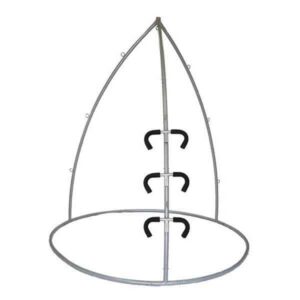
Freestanding Aerial Rig / Yoga Trapeze Stand
A Yoga Trapeze stand is a freestanding frame which supports aerial equipment, such as a yoga swing. They’re typically metal frames that come with a working load limit from the manufacturer, though the angle of the legs limits some movements.2 Check the rating, and what kinds of movement the frame is designed for, before you buy.
Some frames are built for aerial yoga and light conditioning, while larger rigs are made for more dynamic work such as drops and spins, so check what yours is rated for.1
That means you can use aerial hoop (lyra hoop) or other aerial equipment too.
Freestanding rigs cost more than a doorway bar, but they don’t rely on the strength of your ceiling, which is why they’re the usual recommendation for home setups. Many can be used outdoors too, but check the manufacturer’s guidance.1 One option is Uplift Active’s height-adjustable A-frame rig, which adjusts from 5 ft to 11 ft.
Best for: Versatile freestanding rigging
Uplift Active Height Adjustable A-Frame Rig
A clearly rated, stainless steel and magnesium alloy A-frame with a wide height range, from 5 ft to 11 ft.
- Freestanding: no drilling into your ceiling
- 310 lb (140 kg) maximum user weight at 5:1
- Publishes its breaking load and usage limits
- Not for drops, doubles or swinging
- Large footprint at full height
- More expensive than other rigging options
We’ve also compared many other freestanding aerial rigs: read our comparison guide here.
Door Frame Bars
A doorway bar is a low-cost way to hang a yoga swing for gentle, low-to-the-ground work. Its safety depends on your door frame, so check the bar’s weight rating and inspect the frame before you use it.6
Whether a doorway bar can hold you depends on its rating and on your door frame: what it’s made of, how old it is, and how it’s fixed to the wall.6 It is much cheaper than a large frame, though. You can also use it as a pull-up bar to build your upper-body strength!
Best for: A low-cost way to hang a swing for gentle work
DreamGYM Doorway Support Bar
A low-cost way to hang a yoga swing for gentle, low-to-the-ground work. Check its weight rating and inspect your door frame first.
- No ceiling work needed
- Much cheaper than a large frame
- Doubles as a pull-up bar
Ceiling Hooks
A permanent ceiling point is only strong if the structure has been checked and the anchor is professionally installed. Avoid cheap screw-in ceiling hooks: Firetoys warns they aren’t rated for human loads,1 and hammock hooks have been recalled for failing.7 A steel I-beam has published load values, and a beam clamp made for it can create a secure rigging point.2 Wooden joists vary too much to rate by eye, so have a structural engineer assess them.1 A professionally installed ceiling anchor can last for years, as long as you inspect it regularly.
Uplift Active’s ceiling mount hooks are made for aerial yoga. Uplift gives them a working load limit of 330 lb (150 kg) at a 10:1 safety factor when they’re installed correctly, says a licensed contractor or professional rigger with aerial experience must fit them, and says they’re not for aerial silks or drops. Hooks are only ever as strong as the structure they’re fixed into, and you’ll need your own carabiners.

Best for: A professionally installed ceiling point
Uplift Active Ceiling Mount Hook Set of 2
Welded steel ceiling mounts made for aerial yoga, with a clearly stated 330 lb working load limit at a 10:1 safety factor.
- Made for aerial yoga and bungee fitness
- 330 lb (150 kg) WLL at a 10:1 safety factor
- Sold as a pair for two-point swings
- Uplift says a professional should install them
- Not for aerial silks or drops
- Carabiners sold separately
Shop Aerial Rigging at Uplift Active
Multi-Gyms
If you want to add some variety into your workouts, then multi-gyms are a great choice for aerial yoga and more! The Omni Yoga and Trapeze Stand is designed for more than one aerial discipline. Check its rated load and which movements it’s designed for.
Putting it all Together – Aerial Rigging Pieces & Other Accessories
With your main rigging in place, to get the most variety from your workouts you’ll need some extra bits & pieces to extend what’s possible. Here’s a breakdown and explanation of the different aerial rigging accessories and pieces available:
Carabiners
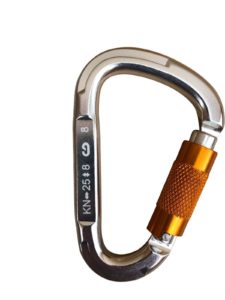
Carabiners are the bread and butter of aerial rigging! Aerialists use these for safely attaching different elements of their rigging together. Use locking carabiners with a strength rating stamped on them. A carabiner is only at full strength when it’s loaded along its long axis with the gate closed and locked; with the gate open, it has only about 30% of that strength.8 Never clip a carabiner directly onto aerial silks.5
Get 10% off Aerial Yoga Clothing & Equipment with Uplift Active

Use the discount code POLEFIT10 at the checkout
“Daisy Chain” Extension Straps
Aerial yoga extension straps are typically a pair of adjustable straps that are fixed between the top bar and the hammock or swing. They can be used to make your yoga swing or hammock longer in length, perfect for higher ceilings or if your swing is just a bit too high off the floor for your preference.
The straps used to hang hammocks and yoga swings are typically a ‘daisy chain’ style of strap. This means the strap has a row of sewn loops, so you can adjust the length one loop at a time.
Clip each carabiner through one loop only. Climbing hardware maker Black Diamond warns never to clip a carabiner into more than one pocket at a time: if the stitching between them fails, you’re no longer clipped in.9 Choose straps sold for aerial use with a stated working load limit. Firetoys, for example, lists a WLL of 185 kg (about 408 lb) for its 5-loop aerial yoga chain.10
Best for: Higher ceilings
Uplift Active Daisy Chain Extender Rope
Nylon daisy chains with 10 adjustable loops, from an aerial yoga store that publishes both the safe load and the breaking load.
- 10 loops to adjust the height one loop at a time
- Safe load and breaking load published
- Sold singly or as a pair
- Safe load 190 lb per rope
- Not for climbing or dynamic moves
See the best Aerial Extension Straps
Aerial Swivel Rotational Devices
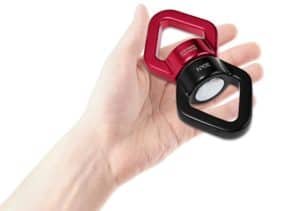
When you’re ready to try a rotating/self-spinning swing, then you’ll need a swivel: a rated rotating connector that sits between two carabiners above your hammock or silks.5 The hammock, hoops or silks won’t rotate without an additional rotational device.
This swivel is designed for aerialists using suspended swings, hammocks and other fitness equipment. A swivel adds length to your setup, so check its length in the product specs and allow for it when you measure your ceiling. If your swing/silks is double-pointed, then you’ll need a bear-paw plate too (see below)
Bear Paw Plate
To spin a two-point hammock from one swivel, you’ll need a rated rigging plate, such as a bear paw plate, or a quick link to bring both sides together.4 Otherwise, you won’t be able to rotate without getting in a twist 😊 Cutely named after the shape of a bear’s paw print, these are really useful to have when you’re ready to step up your aerial workouts to the next level.
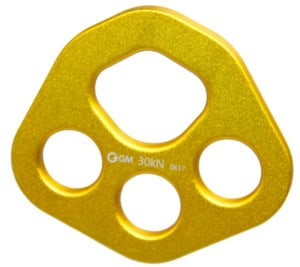
Figure 8 Plate
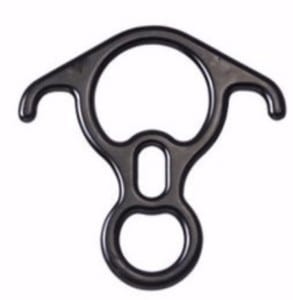
A figure 8 (or rescue 8) is a small metal device you tie your silks onto so they can be clipped into the rigging. It’s compact and handy if you’re short on height. For a more permanent setup, a larger fabric bell separates the two strands of the silk more cleanly.5
Shop Figure 8s for Aerial Silks
Aerial Rigging Hardware at a Glance
| Hardware | What it does | What to check | Notes |
|---|---|---|---|
| Anchor point (freestanding frame, I-beam clamp or professionally installed eye bolt) | Holds the whole system | The frame’s or clamp’s WLL, plus an engineer’s check of the structure | No cheap screw-in ceiling hooks |
| Locking carabiner | Connects each part of the rigging | Strength rating stamped on it | Load along the spine with the gate locked; never clip onto silks |
| Extension straps / daisy chain | Sets the hammock’s height | A stated WLL | One carabiner per loop |
| Swivel | Lets the hammock or silks spin | Rated for aerial use | Sits between two carabiners; adds length |
| Rigging plate (bear paw) or quick link | Joins both sides of a two-point hammock | Rated for aerial use | Needed to spin a two-point hammock from one point |
| Figure 8 / rescue 8 | Attachment point for aerial silks | Breaking strength stamped on it | A fabric bell suits permanent setups |
| Crash mat | Protects you in a fall | At least 8 in (20 cm) deep | Place it under every rigging point |
What’s the Difference Between Working Load Limit and Minimum Breaking Strength?
Working load limit (WLL) is the most load a piece of hardware is rated to carry in normal use. Minimum breaking strength (MBS) is the lowest load at which it’s expected to break.10 Always plan around the WLL, never the MBS, and check every item’s rating, because limits vary between the pieces in your setup.2
What Is a Safety Factor in Aerial Rigging?
A safety factor is the margin between the load that breaks a piece of hardware and the working load it’s rated for. Lifting-hardware maker Crosby calculates it as the ultimate load divided by the working load limit.11 Aerial supplier Firetoys uses 5:1 for steel, 7:1 for synthetic fibers and 10:1 for natural fibers.2
How Often Should You Inspect Aerial Rigging?
Check every piece visually and by hand before each session. Petzl also advises a thorough inspection by a competent person at least every 12 months, or after any exceptional event, such as a hard fall.12 Retire metal parts with visible wear of around 10%, check fabric for holes, ladders and thin spots, and keep a log of how often you use your gear.1
Best Place to buy Aerial Rigging
Uplift Active – Aerial Yoga Gear
X Pole – Leaders in Pole & Aerial Fitness
Sources
- Firetoys, “Installing Aerial Equipment at Home”, 2026. Aerial equipment supplier guidance. ↩︎
- Firetoys, “Aerial Rigging 101: How To Rig At Home Safely”, 2022. ↩︎
- Bergeron-Parenteau A, Ross A and Cossin M, “Maximal dynamic forces exerted by acrobats on nine circus apparatuses”, Circus: Arts, Life & Sciences, 2022. Measured in trained circus acrobats, not aerial yoga. ↩︎
- Firetoys, “How to Rig Yoga Hammocks”, 2023. ↩︎
- Firetoys, “How to Rig Aerial Silks”, 2023. ↩︎
- Hughston Clinic, “Pull-up Bar Injuries”, 2024. ↩︎
- US Consumer Product Safety Commission, “Grand Trunk Recalls Parachute Hammocks Due to Fall Hazard”, 2009. An ordinary hammock, not an aerial yoga product. ↩︎
- Petzl, “Examples of dangerous carabiner loading”. ↩︎
- Black Diamond Equipment, “QC Lab: Daisy Chain Dangers”. About climbing daisy chains. ↩︎
- Firetoys, “Aerial loops, strops, and ropes for rigging”, 2023. ↩︎
- KITO Crosby, “Blocks: Applications & Warnings” (PDF), 2025. Definition of design factor. ↩︎
- Petzl, “What is PPE verification and how do you go about it?”. ↩︎
Save this Guide
Use this image to Pin this guide to aerial yoga rigging to Pinterest!