Aerial yoga looks like something only acrobats can do. It isn’t. Most of my beginners are surprised by how supported they feel the first time they sit back into the fabric, and by how quickly they’re laughing.
I’ve practiced aerial yoga since 2008 and taught yoga since 2013. For years I kept a freestanding frame in the studio where I danced and taught, so I’ve put up, taken down and checked more rigs than I can count. This guide covers what I tell every new student: what aerial yoga is, what it can and can’t do for you, who should check with a doctor first, and what you need to practice safely at home.
The short version
- Take a few classes first if you can, so a teacher can show you how to get in and out of the fabric.
- Check your health: glaucoma, high or low blood pressure, heart disease, pregnancy and some other conditions mean you should talk to your doctor before going upside down.
- Decide where to hang it: a freestanding frame, rated ceiling mounts in a solid joist, or a doorway bar for light work.
- Choose a swing or a hammock: a swing with handles is easier to learn on; a fabric hammock gives you more poses.
- Start low and slow: hang the fabric around hip height, keep the first sessions short, and save full inversions until you’re confident.
What is aerial yoga?
Aerial yoga is yoga practiced with the support of a soft fabric hammock or a yoga swing, hung from the ceiling or from a freestanding frame. The fabric takes some or all of your weight, so you can stretch, balance, strengthen and, when you’re ready, hang upside down.
It goes by a lot of names, depending on where you live and which school taught your teacher. You may see it called:
- Anti-gravity yoga
- Zero-gravity yoga
- Upside-down yoga
- Circus yoga
- Air yoga or flying yoga
- Yoga trapeze (usually a swing with handles)
- Inversion therapy (a term some swing makers use)
They all describe much the same thing. The bigger difference is the equipment. A yoga swing (or trapeze) has a padded seat and handles at different heights. An aerial hammock is one long, wide piece of stretchy fabric with no handles, the kind you’ll find in most studio classes.

Here’s the part that surprises people: for many poses, the hammock makes yoga easier, not harder. It holds your hips in a forward fold, takes weight off your wrists, and lets you sink into stretches you’d fight on the mat.
You don’t need to be young, slim, strong or flexible to start. I’ve taught complete beginners of all ages, including people who hadn’t exercised in years. What you do need is patience, a teacher for the first steps if possible, and equipment rated well above your body weight.
What are the benefits?
Aerial yoga mixes strength, flexibility and a bit of cardio, and the research that exists is encouraging. There isn’t much of it yet, so here’s what the studies actually found, rather than the long lists of miracle benefits you’ll see elsewhere.
- It counts as a real workout. In a small study for the American Council on Exercise, a 50-minute aerial yoga class was moderate-intensity exercise and burned about 320 calories on average. After six weeks of three classes a week, the 16 women taking part had better aerobic fitness, lower systolic blood pressure, higher HDL (“good”) cholesterol and a little less weight and body fat.1
- Flexibility. In a small 2025 study of sedentary women, eight weeks of aerial yoga mainly improved flexibility. Reformer Pilates did more for core stability and balance.2
- Stress, sleep and back pain. Research on yoga in general links it to lower stress and better sleep, and suggests a slight benefit for low-back pain. These studies weren’t on aerial yoga, but the practice shares the breathing, stretching and strengthening.3
You’ll also read that inversions decompress the spine or improve circulation. Hanging does feel wonderful for many people, but the evidence for inversion as a treatment is limited and mostly comes from small studies.4 If you have a back problem, ask your doctor or physical therapist first.
What I see most in my students is less measurable: confidence. The first time someone trusts the fabric enough to let go and hang, something changes. Our guide to the health benefits of aerial yoga goes into the research in more detail.
Who should check with a doctor first
Aerial yoga is gentle in many ways, but going upside down isn’t for everyone. Talk to your doctor before you try inversions if you have high or low blood pressure, heart disease, glaucoma or another eye condition, acid reflux, or a history of stroke or brain injury, or if you’re pregnant.4
- Eyes: head-down positions cause a rapid rise in the pressure inside your eyes, in healthy eyes and in people with glaucoma.5
- Pregnancy: doctors advise avoiding activities that could lead to a fall, so this isn’t the time to learn aerial work.6
- Injuries: in yoga generally, the most common injuries are sprains and strains, and serious ones are rare. Learning on your own without supervision has been linked to a higher risk.3
Even if none of these applies to you, come out of inversions slowly and sit up for a moment before you stand. Our guide to whether aerial yoga is safe covers the risks in more depth.
How to practice aerial yoga at home
If you can, start with a local class. Many yoga studios and gyms now run aerial sessions, and a few lessons will teach you how to climb in, how to come out of an inversion and how the fabric should feel when it’s set at the right height. Our guide to choosing an aerial yoga class tells you what to look for.
Classes don’t suit everyone, though. They may clash with work, be an hour’s drive away, or just not fit around your life. Practicing at home lets you build a routine on your own schedule, and plenty of my students practice between classes once they know the basics.

When you start at home, this is how I’d do it:
- Hang it low. For a first session, set the base of the fabric around hip height. You can always raise it later.
- Clear the space. Leave room to swing in every direction, and put a crash mat or a thick mat underneath. See our crash mat guide.
- Check everything, every time. Look over the fabric, carabiners, straps and fixings before you climb in, and give the fabric a firm pull with your weight still on the floor.
- Start with supported poses. Seated stretches, a standing chest opener and a supported forward fold come before anything upside down. Try our yoga swing poses for beginners and 20-minute stretch routine.
- Keep it short. Twenty to thirty minutes is plenty at first. Hanging is tiring in ways you don’t notice until the next day.
- Have someone nearby the first few times you invert at home.
Wear fitted clothes that cover your underarms and the backs of your knees, because the fabric can rub. Our guide to what to wear for aerial yoga explains why.
Aerial yoga equipment: what you need
Home aerial yoga needs only three things:
- Something to hang from: a freestanding frame, rated ceiling mounts fixed into a solid joist or beam, or a doorway bar for light use.
- The fabric: a yoga swing with handles, or an aerial hammock.
- The connectors: load-rated carabiners and straps (daisy chains or slings) that join the fabric to the rig. A swivel for spinning is optional, and comes later.
Every part needs a published rating comfortably above your body weight, because your rig is only as strong as its weakest link. Our aerial yoga equipment guide lists everything in one place, and the products below are a starting point I’d be happy to see in a student’s home. All were on sale at the makers’ own stores when we checked.
| Where to hang it | Drilling | Good for | Watch out for | Our guide |
|---|---|---|---|---|
| Freestanding frame | None | Renters, garden practice, ceilings you can’t trust | Floor space, and lower load limits at full height | Best stands |
| Ceiling mounts | Yes, into a solid joist or beam | A permanent set-up that takes up no floor space | Needs a sound structure and, ideally, a professional to fit it | Ceiling hooks |
| Doorway bar | Screws into the door frame | Light, low swing work | Lower ratings and limited height, so not for inversions | Door frame bars |
Freestanding frames
A frame is the most flexible way to practice at home: no drilling, nothing to explain to a landlord, and you can carry it into the garden on a summer evening. The trade-off is floor space. Check the footprint and the height against your room before you order, and remember that a frame needs level ground and its straps or weights every time.

Best for: A freestanding rig for home or garden
X-Pole A-Frame
A load-tested, height-adjustable aerial rig that handles hammocks, hoops and low silks, and packs into carry bags.
- Independently load tested: 140 kg (308 lb) working load limit at 5:1
- Adjusts from 8 ft to 11.42 ft
- Carry bags, stabilization straps and weight bags included
- Load limit drops to 80 kg (176 lb) at full height
- Large footprint at full height (95 sq ft)
- Sand for the weight bags not included
- One of the pricier stands
The X-Pole is the frame I’d pick if you want room to grow into hoop or low silks later. X-Pole says it isn’t designed for dynamic drops. Read our full X-Pole A-Frame review.
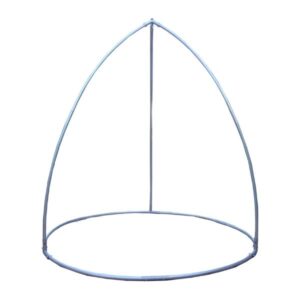
Best for: Yoga swings under an 8 ft ceiling
Omni Gym Pyramid Stand
A compact pyramid stand built for yoga swings, with a built-in swivel and a 7 ft 11 in version for standard ceilings.
- 7 ft 11 in option fits under most 8 ft ceilings
- Built-in 360-degree swivel
- One person can assemble it in about 15 minutes
- Height is fixed, not adjustable
- 300 lb (136 kg) recommended maximum
- Made for yoga swings, not hoop or silks
If you want a handled swing indoors under a standard ceiling, the Omni Gym stand is the simpler choice. Our best aerial yoga stands guide covers it in more detail. For a heavier steel frame with a higher rating, the Prodigy Aerial Yoga Rig R29 is rated to 230 kg (505 lb) at 5:1, with a 2.0 m setting for lower rooms.
Ceiling mounts
Fixed into a solid joist or beam, a pair of ceiling mounts is the strongest and tidiest home set-up. The mount itself is rarely the weak link. What matters is the timber or concrete behind it and how it’s fixed, so I’d always ask a builder or a qualified rigger to check the structure and fit them.

Best for: A rated ceiling point in a solid joist
Uplift Active Ceiling Mount Hook Set of 2
Welded steel ceiling mounts made for aerial yoga, with a stated 330 lb working load limit at a 10:1 safety factor and wood or concrete fixings.
- 330 lb (150 kg) WLL at a 10:1 safety factor
- Made for aerial yoga and bungee fitness
- Wood bolts or concrete expansion bolts
- Must be fitted by a licensed contractor or professional rigger
- Not for silks, circus arts or drops
- Your joist still sets the real limit
Our guide to yoga trapeze ceiling hooks compares mounts, and our aerial rigging guide explains joists, spacing and hardware.
Doorway bars
A bar that screws into a wooden door frame is the cheapest way to hang a yoga swing, and it’s fine for gentle, low work. It’s not where I’d learn inversions: you’re limited by the height of the door, and doorway bars are usually rated lower than a good frame or ceiling mount. Check the welds and fixings too: a doorway swing bar sold for children was recalled in the US because its welded eye hook could break, posing a fall hazard.7
Our yoga swing door frame guide explains which bars to look for and how to check your frame.
Yoga swings and aerial hammocks
For most beginners at home, I’d start with a swing with handles. The handles give you something to hold while you find your balance, and the seat makes supported inversions feel secure. A fabric hammock is what most studios use. It has no handles, so there’s more to learn, but it opens up far more poses, wraps and cocoon rests.
Whichever you choose, look for a published load rating, not just “heavy duty”, and a length that suits your ceiling or frame.
Best for: Beginners who want handles and padded foot stirrups
Omni Gym Swing Pro
A padded yoga swing with six handholds and built-in height adjustment. Hanging hardware is extra.
- Padding sewn into the seat and the foot stirrups
- Height-adjustment loops built into the long handles
- One-year parts warranty and 30-day money-back guarantee
- 300 lb (136 kg) user limit, 250 lb with the spring trapeze
- No daisy chains, ceiling plate or stand in the box
- Premium price for a swing
Our guide to the best aerial yoga hammocks and swings compares the ones worth buying, including the Omni Gym Swing Pro if you want handles.
Best for: A complete first hammock kit for home aerial yoga
Uplift Active Hammock (Low Stretch) Set
Low-stretch 40 denier nylon tricot, rated for users up to 400 lb, with steel locking carabiners and daisy chains in the box. Mounts or a frame sold separately.
- Rated for users up to 400 lb (181 kg)
- Two steel screw-lock carabiners and two daisy chains included
- Five lengths, sized to your ceiling
- Each daisy chain has a 190 lb safe load, so rig from two points
- No published safety factor for the fabric
- Ceiling mounts or a frame sold separately
Read our full Uplift Active hammock review. For a hammock with a published working load limit and safety factor, the Firetoys 6 m hammock is rated to 172 kg (379 lb) at 7:1 and comes with rated O-rings.
Get 10% off Aerial Yoga Clothing & Equipment with Uplift Active

Use the discount code POLEFIT10 at the checkout
We compare more options in our guide to the best aerial yoga hammocks and swings.
Connectors and accessories
Between the fabric and the rig, you’ll need locking carabiners and straps. Many hammock sets include them, but check the rating on every piece. Daisy chains are the easiest way to adjust the height: you clip into a higher or lower loop rather than retying anything. Clip into one loop only, never across two: if the stitching between the loops fails, you’re no longer clipped in.8 Our guide to extension straps explains why.
Once you’re confident, you may want to spin. That needs a rated swivel at a single hanging point, plus a rigging plate if your swing hangs from two points. It also adds a few inches of drop, so allow for that. I’d leave spinning until you can get in and out of every pose calmly. Uplift Active sells an aerial swivel and a 30 kN rigging plate. If you hang a swing from an Omni Gym stand, don’t add a swivel, because the stand has one built in.
For cushions, ladders, posters and other extras, see our round-up of aerial yoga accessories.
Other aerial disciplines to try later
Aerial yoga is a gentle way into the air, and plenty of my students have gone on to other aerial arts once they caught the bug. They need more strength and more training, so learn them in a class first.
Aerial hoop (lyra)
A steel hoop hung from one or two points, used for spins, poses and balances. Some freestanding frames, including the X-Pole A-Frame, can take a hoop too. See our guide to the best aerial hoop for home use.

Aerial silks
Two long lengths of fabric hung from a single point, climbed and wrapped rather than sat in. Silks need much more height than a home frame gives, so at home you’re limited to low work. See our guide to the best aerial silks for beginners. If you already own an X-Pole dance pole, our X-Pole SILKII review covers the attachment that lets you hang a silk from it.

There’s also flying pole, a dance pole hung from the ceiling so it swings, which is one of the hardest aerial disciplines of all. Read about it and a few others in 5 unique and innovative aerial sports to try.
Tips for buying aerial yoga equipment
Buying aerial kit isn’t like buying a yoga mat. It holds your whole body weight while you’re off the ground, often upside down, so safety comes before price or color. These are the things I check first.
Weight limit
Check the rating of every part: frame or mounts, straps, carabiners and fabric. Look for a working load limit (the most it should carry in normal use) or a maximum user weight, not just a breaking strength. Moving in a hammock puts more force through it than hanging still, which is why good makers build in a safety factor. Our guide to the aerial yoga weight limit explains the numbers. We check every product’s published ratings on the maker’s own page before we recommend it.
How you’ll install it
Decide where your swing will hang before you buy anything else. A frame, ceiling mounts, a doorway bar and a sturdy tree branch all need different hardware and lengths of fabric. If you’re drilling into a ceiling, find the joist first and get the structure checked. Our step-by-step guide to installing an aerial yoga hammock at home walks you through it.
Your space
You need more room than you think. When I set up a frame for a class, I’d clear a good arm’s length beyond where anyone’s feet could swing, then move anything with a sharp corner. Check the ceiling height, the floor space around the fabric and what’s underneath you. A soft landing matters more than a pretty room.
Type and size of swing
Swings come with one, two or three pairs of handles, and some have padded seats or foot stirrups. Hammocks come in different lengths and stretches. Measure the distance from your hanging point to the floor and check it against the maker’s sizing chart, because too little fabric is a bigger problem than too much.
Material
Most good hammocks are knitted nylon tricot or polyester, with a low or medium stretch. Swings are often heavier fabrics such as rayon. Whatever the fabric, buy from a seller who tells you what it’s made of and what it’s rated to. I’d avoid unbranded swings from marketplace sites that give no rating at all: you don’t know what you’re getting, and you can’t ask anyone.
There are safe budget options, so you don’t need the most expensive kit. You just need kit with honest numbers.
Questions beginners ask
Can complete beginners do aerial yoga?
Yes. You don’t need any yoga experience, strength or flexibility to start, because the fabric supports you. Beginners’ classes start with seated and standing poses with the hammock low, and build up to inversions over several sessions. The one thing to do first is check whether any health condition means you should avoid going upside down.
How high should I hang my hammock?
For most beginner work, set the lowest point of the fabric around hip height. That lets you sit into it easily and keeps you close to the floor. Some poses call for it higher or lower, which is where adjustable daisy chains help. Always follow the maker’s guidance for your swing or hammock.
Is aerial yoga harder than regular yoga?
Some poses are easier, because the hammock takes your weight. Others ask more of your grip, core and shoulders. The bigger difference is the learning curve: getting in and out of the fabric safely takes practice. Our comparison of aerial yoga vs. regular yoga goes through it in detail.
Can I learn aerial yoga at home without classes?
You can practice gentle, supported poses at home, but I’d learn inversions with a teacher first, in person or live online. Learning yoga without supervision has been linked to a higher risk of injury.3 A few lessons teach you how to enter and exit safely, which is the part videos can’t check for you.
Sources
- Lance C. Dalleck and Daniel J. Green, “ACE-Sponsored Research: Can Aerial Yoga Take Your Workouts to Another Level?”, American Council on Exercise (ACE) ProSource, January 2016. A study of 16 healthy women aged 18–45 taking three 50-minute classes a week for six weeks. ↩︎
- Demirli A, et al., “Effects of Aerial Yoga and Reformer Pilates on Core Stabilization, Flexibility and Balance: A Comparison on Sedentary Women”, Journal of Sports and Science, 2025. A study of 36 sedentary women over eight weeks. ↩︎
- National Center for Complementary and Integrative Health (NCCIH), “Yoga: Effectiveness and Safety”. This covers yoga in general, not aerial yoga. ↩︎
- Cleveland Clinic, “Inversion Tables Might Flip the Script on Back Pain”, 2025. ↩︎
- Jasien JV, et al., “Intraocular Pressure Rise in Subjects with and without Glaucoma during Four Common Yoga Positions”, PLoS One, 2015. ↩︎
- American College of Obstetricians and Gynecologists (ACOG), “Exercise During Pregnancy”, September 2024. ↩︎
- US Consumer Product Safety Commission, “aDOORable Swing Bar Recalled by Sportime Due to Fall Hazard”, 2011. ↩︎
- Black Diamond Equipment, “QC Lab: Daisy Chain Dangers”, Black Diamond QC Lab. ↩︎
Get Aerial Yoga Tips Sent Directly to Your Inbox
Join our mailing list to be the first to know about the latest aerial yoga news and products. We only include the best content in our newsletter, which includes marketing material. Read our Privacy Policy


