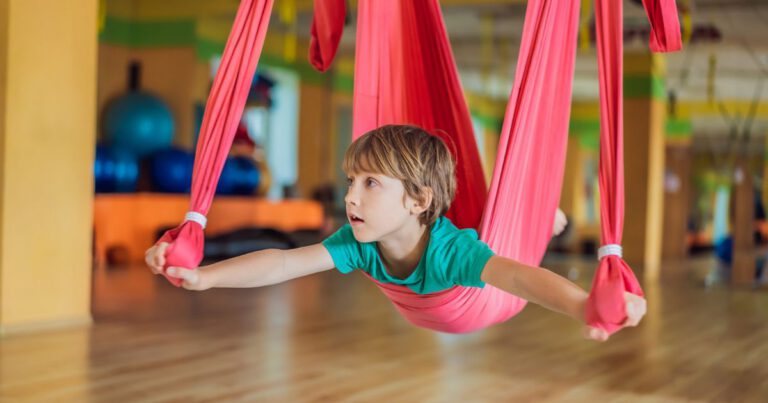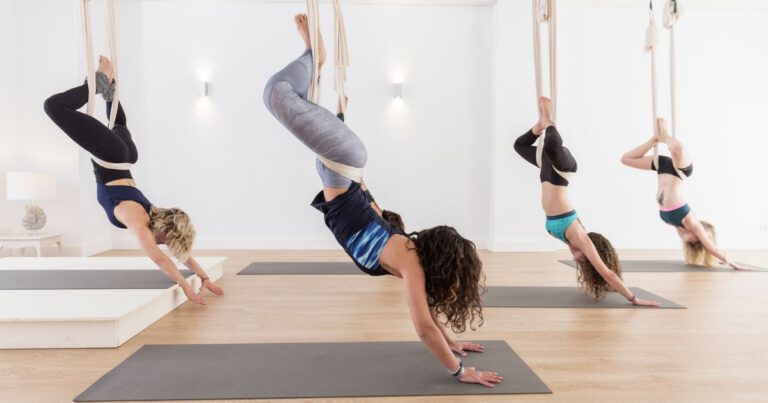

This article covers how to tie knots in an aerial yoga hammock.
Aerial yoga hammocks are made from the same kind of soft fabric as aerial silks, but they’re rigged differently. Most hammocks are tied onto carabiners, O-rings or slings with a simple knot that you can learn to tie yourself.
If you hang your own aerial yoga hammock at home, you need to know how to tie the rigging knot correctly, every time. Until you’re confident, have a qualified rigger or instructor check it.1
In this post, we’ll show you how to tie the most common aerial yoga hammock knots step by step, explain how aerial silks are rigged differently, and share tips for creating secure, reliable knots.
How do you tie a knot in an aerial yoga hammock?
Line up the fabric ends and gather them into even folds. Wrap the fabric over your arm with about 3 feet of tail at the front, then pull the long end through the loop.1 Clip a locking, rated carabiner through the loop, tuck the tail through, and pull everything tight.2 Check it before every session.
How to Tie a Basic Aerial Yoga Hammock Knot
The most basic hammock knot is tied like this:
- Line up the ends of the fabric. Gather it into small, even folds so it bunches like a rope, equal in thickness, and walk your fingers along it to remove any twists. An elastic tie around the ends keeps them aligned.2
- Place the silk over your left arm with the shorter end hanging over the front (for securing to a carabiner or O-Ring) This short part should be about an arm’s length (roughly 3 feet).1
- Hold the shorter end in your other hand out to the right.
- Use your left hand to grab the silk hanging down from the same arm, by passing your left hand over the length held by your right hand.
- Then release the right side and use that hand to help you pull your hand up through the loop you’ve created in the silk.
- Clip a locking, aerial-rated carabiner through the loop. Tuck the tail through the same loop, then pull hard on the long end and the tail until the knot is tight.2
How to Tie Other Aerial Yoga Hammock Knots
Overhand Knot
Method
The overhand knot is another way to tie an aerial yoga hammock onto an O-ring or carabiner. It starts the same way as the basic knot above: gather the fabric and wrap it over your arm. Watch the video for the rest of the steps.
Bowline Knot
Method
It’s best to attempt this one with your hammock laid out on the floor
- As with the basic knot, gather the silk up in small folds so that it is like a rope, equal in thickness when done
- Lay your silk out, and at one end make a loop in the silk by looping around an arms length over the rest. keep it gathered, with room inside so you can fit your arm through.
- Next place Carabiner or O-Ring on the short end
- Move your right hand from the top and through the small loop you made, use your other hand to pass the remaining short end to your right hand so you can pull it through the loop. Be careful, keep the silk as neat as possible with space in the loop.
- Use your left hand to hold the silk loop steady, and place the remaining short end over the developing knot to the right.
- Next the short end will pass under the long part of the silk, and be put back through the loop so it is on the ground side
- Hold both sides where the silk is still free and tighten the knot while retaining a gap where the carabiner or Oring is. Keep going until the knot is tight and secure.
Safety note: a bowline can work loose when it isn’t loaded, and a hammock hangs unloaded between sessions. Back it up with a stopper knot and check it every time before you get in.3
More Hammock Knots on Video
Some knots, like the Prusik, use a separate loop sling. Others, like the daisy chain, are easier to follow on video. A Prusik is a friction knot: you wrap a loop sling twice around the gathered fabric and leave at least 6 inches (15 cm) of fabric below the sling.4 Firetoys recommends sling setups for static aerial yoga rather than dynamic moves.5 A daisy chain takes up extra length when your fabric is too long for the space; the last video also shows one way to tie a silks knot.6
Sling Knot
Prusik Knot
Daisy Chain/Braid
Are Aerial Silks Rigged the Same Way as an Aerial Yoga Hammock?
No. Aerial silks are usually tied onto a rescue 8 (figure 8) or a fabric bell, with knots such as a Prusik or clove hitch. Carabiners then connect that hardware to the anchor, and should never clip straight onto the silks.6 Yoga hammocks are often tied onto O-rings, carabiners or loop slings instead.5
For the full silks setup, including the figure 8, fabric bell and swivel, see our guide to how to rig aerial silks.
Aerial Yoga Hammock Knots at a Glance
| Knot | What it’s for | Notes |
|---|---|---|
| Arm-wrap hammock knot | Tying a yoga hammock onto a carabiner or O-ring | The method in the first video and steps above |
| Overhand (hammock) | Another way to tie a hammock onto an O-ring or carabiner | Video only |
| Bowline | Tying a hammock onto an O-ring or carabiner | Can loosen when unloaded, so back it up with a stopper knot |
| Prusik | Attaching the fabric to a loop sling | Wrap twice; leave at least 6 in (15 cm) of tail; best for static aerial yoga |
| Daisy chain | Taking up extra length when the fabric is too long | Tied in the spare fabric |
⚠ Things to Be Aware of When Tying Hammock Knots
Use locking carabiners or O-rings rated for aerial use, and big enough to hold all the fabric without crowding.1
A knot is only as good as the way it’s tied. Before every session, check that the fabric and knot are in good shape and tied correctly, then load it gently at first.4
Practice makes perfect, keep repeating the knot to become sure of the process and more confident in your abilities.
Learn with a qualified instructor before you practice alone at home. They’re invaluable when you’re starting out: they can check your knots and tell you when you’re ready to train solo.7
Hammock Rigging and Safety
Always have a qualified aerial rigger check your setup and knots, especially when you’re new to rigging. Have your anchor point assessed by a professional rigger or structural engineer before you install anything,5 and don’t use cheap screw-in ceiling hooks, which aren’t rated for human loads.7 Inspect your aerial hardware before each use, especially where metal parts touch each other, and retire anything with visible wear.7
Always put a crash mat under your rig when you practice aerial silks or aerial yoga at home. Firetoys recommends one at least 8 inches (20 cm) deep.7
Take off jewelry, rings and watches before you train, and avoid zippers or anything else that could snag the fabric.8 Tie long hair back, too.
Finally, wear suitable clothing: full-length leggings that cover the backs of your knees and a fitted top.9 And never let children use an aerial yoga hammock unsupervised.4
Does a Knot Weaken Aerial Fabric?
Yes. Knots weaken the material they’re tied in,10 and a knotted rope almost always breaks just where it enters the knot.11 Aerial retailers report that holes in fabric often form inside or near the top knot, so untie it regularly to inspect that area,8 and replace fabric with holes, ladders or thin spots.7 Here’s how to wash your aerial silks safely.
Get 10% off Aerial Yoga Clothing & Equipment with Uplift Active

Use the discount code POLEFIT10 at the checkout
Aerial yoga hammocks are usually tied onto locking, rated carabiners, O-rings or slings with a wrapped knot, figure 8 or Prusik. Aerial silks are rigged on a rescue 8 or fabric bell instead (here’s how to rig aerial silks). Whatever the knot, tie it neatly, leave enough tail, and check it before every session.
A well-tied, checked knot is one part of a safe setup, along with a professionally installed anchor point, rated hardware, a crash mat and good instruction. Aerial work carries a real risk of injury: one study of circus artists found higher injury rates in aerial than in ground acrobatics.12
With time, practice and patience, you’ll soon be able to tie your hammock knots with ease!
Sources
- Uplift Active, “How to Tie a Yoga Hammock Knot (pt 2): Figure 8 Knot”. ↩︎
- Uplift Active, “Yoga Hammock Instructions”. ↩︎
- Animated Knots, “Bowline Knot”. ↩︎
- Yogalaxy, “How to Tie an Aerial Yoga Hammock”, including the manufacturer’s safety instructions. ↩︎
- Firetoys UK, “How to Rig Yoga Hammocks”, 2026. ↩︎
- Firetoys UK, “How to Rig Aerial Silks”, 2023. ↩︎
- Firetoys UK, “Installing Aerial Equipment at Home”, 2024. ↩︎
- NetJuggler, “Snags, Holes and Tears in your Aerial Fabric”. ↩︎
- Dragonfly, “Aerial Silks for Beginners: What to Wear and Expect”, 2026. ↩︎
- Animated Knots, “100% Strength”. ↩︎
- Saitta AM, Soper PD, Wasserman E and Klein ML, “Influence of a knot on the strength of a polymer strand”, Nature, 1999. ↩︎
- Greenspan S and Stuckey MI, “Untangling risk factors including discipline-specific exposure for injuries in preprofessional and professional circus artists in the USA”, BMJ Open Sport & Exercise Medicine, 2023. ↩︎