
This article covers how aerial silks are rigged, and the knots used to tie them onto a figure 8 or fabric bell.
Aerial silks look effortless in the air, but everything you do on them depends on what’s happening at the very top of the fabric. Knowing how your silks are rigged helps you understand your setup, ask your rigger the right questions and spot problems before you climb.
How do you rig aerial silks?
Aerial silks are tied onto a figure 8 (rescue 8) or a fabric bell, never clipped straight to a carabiner. Carabiners then connect the figure 8 or bell to a swivel, if you want to spin, and to a safe anchor point.1 Have a qualified rigger set up and check your silks before you climb.2
You will learn:
- How aerial silks differ from aerial yoga hammocks
- What each piece of silks rigging does
- The knots used to tie silks onto a figure 8 or fabric bell
- How to tie two silks side by side
- How to shorten or lengthen your silks
- The safety checks to make before every session
Aerial Silks vs Aerial Yoga Hammocks: How Is the Rigging Different?
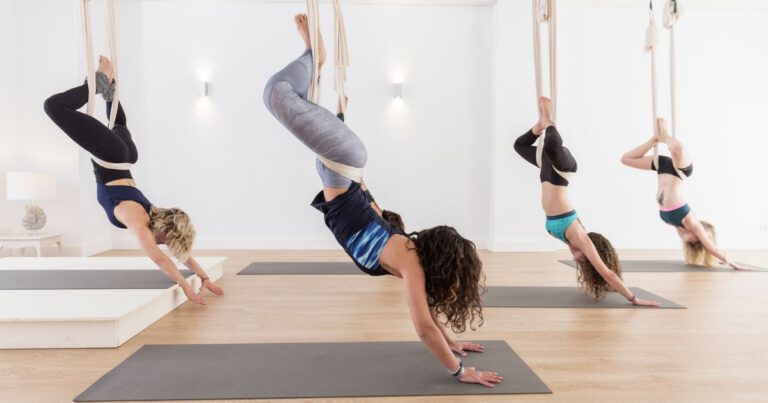
Aerial silks (also called aerial fabric or tissu) are two long tails of fabric hanging from a single point. You climb them, wrap them around your body and drop through the wraps. An aerial yoga hammock is a loop of fabric hung low to the ground, usually from two points, so you can sit, lie back and go upside down in it.
Because silks are used for climbs and drops, they’re rigged differently. A single silk is usually folded in half over its figure 8 or fabric bell to make the two tails,3 and the hardware is chosen to spread the load and stop the fabric from slipping.1 If you’re setting up a yoga hammock instead, see our guide to aerial yoga hammock knots.

Aerial Silks Rigging Equipment
Every setup is slightly different, but aerial equipment maker Firetoys gives this as an example of a basic aerial silks rig, from the anchor point down:1
- A safe anchor point, assessed by a structural engineer or professional rigger
- A carabiner
- A swivel, if you want to spin
- A second carabiner
- A figure 8 or fabric bell, with the silk tied onto it
| Piece | What it does | Good to know |
|---|---|---|
| Figure 8 (rescue 8) | Holds the top of the silk | Small and light, so it suits short-term setups and lower ceilings. Its “ears” help separate the fabric, making the center easier to find in the air. |
| Fabric bell (fabric hook) | Holds the top of the silk | A larger surface spreads the load and reduces the chance of tears. Better for permanent setups. |
| Carabiner | Connects the hardware together | Never clip it straight onto the silk. Load it in line with its spine. |
| Swivel | Lets the silks spin | Only needed if you want to spin. |
| Strop, loop or spanset | Adds length, or wraps a beam to make an anchor | Only around a beam that has been checked by a professional. |
Every piece should be rated for aerial use, with a stated working load limit.4 Our aerial rigging guide explains working load limits and safety factors in more detail.
Knots Used to Rig Aerial Silks
The knot depends on the hardware. A figure 8 takes a simple knot, so silks can be tied on quickly and easily. Fabric bells offer a wider choice of knots, which give a cleaner separation between the two strands of the silk without it slipping.1 These are the knots you’ll come across most:
Figure 8 Knot
The silk is threaded through the center of the figure 8, split around its head and brought back through, then pulled tight. It’s a simple knot that’s quick to tie and untie, which suits setups that come down often.1 You can see the same steps in the two-silk method below.
Prusik Knot
A friction knot used to attach a loop around an object.1 It’s one of the knots used to tie silks onto their attachment point.
Single and Double Clove Hitch
A clove hitch is a crossover knot used to tie the middle of a rope, or a silk, to an anchor. The double clove hitch is a more secure version that can be used on larger fabric bells.1
Rigging knots are best learned hands-on. Online guides like this one aren’t a substitute for professional, in-person instruction,4 so have a qualified rigger or instructor show you each knot, and check yours, before you climb.
How to Tie Two Aerial Silks Side by Side on a Figure 8
Two silks tied side by side, each used at full length rather than folded in half, give you two-tone tails. They can also be a cost-effective way to get extra length for a high rigging point.3 This is how Firetoys ties them onto a figure 8:
- Line up the ends of both silks side by side.
- Thread both ends together through the center of the figure 8.
- Split the fabric around the head of the figure 8.
- Bring the tails back through the center of the silks, then through the middle of the figure 8.
- Bring the tails together behind the top of the figure 8 and tie a stop knot.
- Pull the silks down through the figure 8 to tighten the knot, then pull the tails through to neaten everything up.
Firetoys rates its own medium-stretch silks at a 150 kg (about 330 lb) working load limit in this setup, with a 7:1 safety factor.3 That figure applies to that fabric and figure 8 only, so check the ratings for your own equipment.
How to Shorten or Lengthen Aerial Silks
Too short? Add a strop or loop to the rigging to bring your silks lower to the ground. Firetoys recommends keeping at least 2 meters (about 6.5 feet) of tail.
Too long? Tie the silk onto the figure 8 where you want it, feed the extra fabric through, and take up the excess with a daisy chain.1
Aerial Silks Safety Checks
- Get your anchor point assessed. Speak to a professional rigger or structural engineer before anything is installed.2
- Remember the forces involved. In a study of trained circus acrobats, researchers measured peak forces of 5.6 times body weight on aerial silks.5
- Inspect the fabric. Look for holes, ladders and thin areas,4 especially at the very top of the rigging, where damage can hide in the knot or near the anchor point. NetJuggler suggests untying the top knot once a month to check that area.6
- Check the metal. Retire hardware with visible wear of around 10%.4
- Use a crash mat at least 20 cm (about 8 inches) deep.4
- Wash with care. Follow our guide to washing aerial silks, and never tumble dry them, because it damages the fibers.7
Can You Clip a Carabiner Straight Onto Aerial Silks?
No. Carabiners connect hardware to hardware, such as a figure 8, fabric bell, strop or swivel. They must not be attached directly to silks, and should only be loaded in line with their spine.1 Tie the silk onto a figure 8 or fabric bell first, then clip the carabiner to that.
Figure 8 or Fabric Bell: Which Is Better for Aerial Silks?
It depends on your setup. A figure 8 is small, light and quick to tie, so it suits short-term setups and lower ceilings. A fabric bell has a larger surface that spreads the load and reduces the chance of tears, and it separates the two strands more cleanly, so it suits permanent setups.1
Get 10% off Aerial Yoga Clothing & Equipment with Uplift Active

Use the discount code POLEFIT10 at the checkout
Further Reading:
- How to Tie Aerial Yoga Hammock Knots
- Best Aerial Silks for Beginners
- How to Wash Aerial Silks, Yoga Swings & Hammocks
- Aerial Rigging Guide
- How to Install an Aerial Yoga Hammock at Home
Sources
- Firetoys UK, “How to Rig Aerial Silks”, 2023. Aerial equipment maker guidance. ↩︎
- Firetoys UK, “How to Rig Yoga Hammocks”, 2026. ↩︎
- Firetoys UK, “Tying Dual Colour Aerial Silks”, 2022. ↩︎
- Firetoys UK, “Installing Aerial Equipment at Home”, 2024. ↩︎
- Bergeron-Parenteau A, Ross A and Cossin M, “Maximal dynamic forces exerted by acrobats on nine circus apparatuses”, Circus: Arts, Life & Sciences, 2022. ↩︎
- NetJuggler, “Snags, Holes and Tears in your Aerial Fabric”. ↩︎
- Firetoys UK, “Aerial Silks and Slings Information Page”. ↩︎