
Do you dream of being able to do the splits? Have you been doing stretches and working out for months but haven’t seen any progress? If so, this article is for you!
In many sports and activities, flexibility (how far your joints can move through their range) is an important quality. Even when stretching isn’t directly part of your sport, it helps keep your muscles flexible. Tight muscles can’t extend all the way, and that can leave them open to strains when they’re suddenly asked to stretch.1
How can you get the splits faster?
Stretch regularly, ideally every day, and warm up first with five to 10 minutes of light activity such as a brisk walk.1 Hold each stretch for 10 to 30 seconds.2 The American College of Sports Medicine recommends flexibility exercises for each major muscle group on at least two days a week, adding up to about 60 seconds per stretch.3 Don’t bounce, stop at tension rather than pain, and be patient: it takes weeks to months to get more flexible.1
1. Stretch Every Single Day
If you want to be able to do the splits faster, you should stretch every day. Regular stretching keeps your muscles flexible, so that over time you can ease yourself into graceful positions. Stretch once your muscles are warm, after a short warm-up or at the end of a workout, because stretching cold muscles can hurt them.1
One thing stretching won’t do is flush out lactic acid. The idea that trapped lactic acid causes the soreness you feel after exercise is a myth.4 That delayed soreness comes from tiny tears in your muscle fibers as they get used to new work,5 and a Cochrane review found that stretching before or after exercise makes little real difference to it.6
Stretching is good for people who are participating in sports that require flexibility like gymnastics, dance, diving, and martial arts. It’s also good for anyone who simply wants to keep a good range of motion in their joints.1
It isn’t hard to find time to stretch especially if you work at a desk all day long. Before getting up from your seat, try stretching your arms and hands as well as your back and neck. Throughout the day try standing up occasionally from your desk and stretching your legs, for example with a gentle standing calf stretch: hold on to your desk, step one foot back, keep that heel on the floor and the knee straight, and lean forward slightly until you feel a stretch in your calf.
2. Stretch For The Splits In Both Directions
You should stretch for the splits on both sides: with your left leg forward and with your right leg forward. If you only ever practice one side, you’ll end up with one good split and one tight one. It’s common to have a tighter side, so give it the same time and attention (or a little more).
There are also two main types of splits: front splits, with one leg forward and one back, and middle (or side) splits, with your legs out to either side. Our goal is to be able to do both.
Working both sides evenly also stops you from forcing your favorite side deeper and deeper. Your body needs time to adapt, so steady practice on both sides beats pushing one side as far as it will go.
2a. What About Standing Splits?
Don’t forget about the standing splits! Use a door frame, vertical pillar or pole dancing pole to stretch for the splits in the vertical position.
You can stretch your muscles in different positions to achieve the same benefits.
3. Stretch With A Partner
One of the best ways to achieve the splits is by stretching with a partner, especially if you’re trying to achieve it quickly. It’s easy to get injured if you try to force yourself into a stretch you’re not ready for.
But if you have someone guiding you in the right way, stretching with a partner can be very helpful. This way, they can give you feedback when to go deeper and also help you stay safe while doing so.
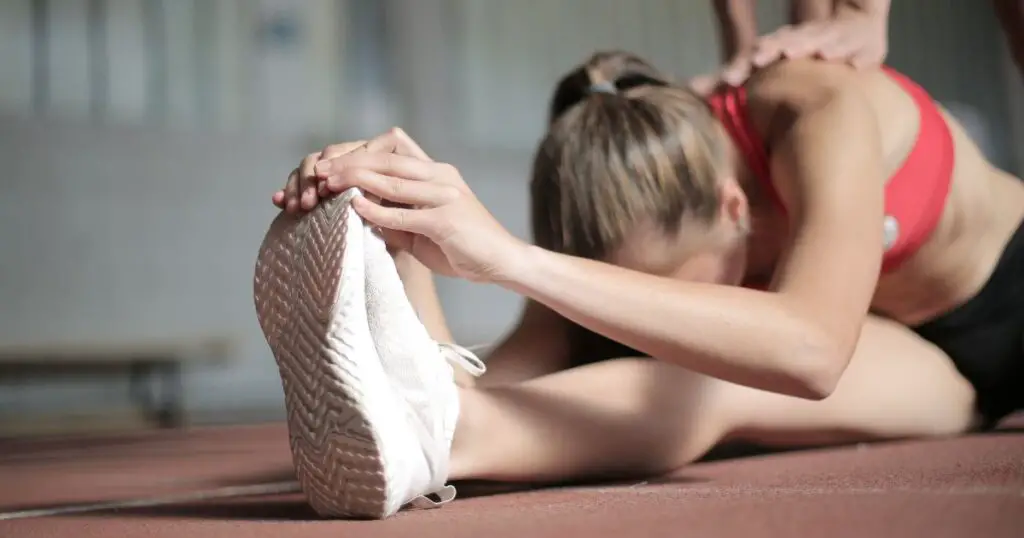
Several years ago, I was in a dance class where stretches were central to the curriculum. We were given stretches to do on our own, but then we’d pair up and help each other ease a little deeper into them.
The stretches felt better because we had someone else supporting our bodies while we stretched them.
If you try partner stretching, agree on a clear signal before you start, and tell your partner the moment you want them to ease off. Your partner should use slow, gentle pressure and never push or bounce you into a position. You should feel tension, not pain. If it hurts, stop.1
4. Use Flexibility Aids
Best for: Stretching anywhere, any time
Stretch bands
One of the most popular flexibility aids: an anchored loop for your foot and a long, stretchy strap.
- Slip your foot into the anchored loop
- Usually comes with a step-by-step guide
- Stretch almost anywhere, any time
Many people use flexibility aids to improve their flexibility.
Stretch bands and other flexibility aids are some of the most popular products on the market today, and for good reason!
Some of them are fun, some of them are inexpensive, and some of them can help you hold a stretch in a better position.
You can stretch almost anywhere, anytime, so it’s easy to work your flexibility into your daily routine.
The most popular of these are stretch bands, which usually consist of an anchored fabric loop that you can slip your foot into and a long, stretchy strap that stretches when your foot does.
The device will typically come with a step-by-step guide to help you use it properly.
5. Use Yoga Blocks
Best for: Deepening your stretches
Yoga blocks
Put them under your hands or hips for support, so you can ease into a split gradually instead of forcing it.
- Support you while you ease into a stretch
- A great addition to a home gym or yoga area
- Won't break the bank
Yoga blocks are awesome for stretching with. Put them under your hands, or under your hips in a front split, to take some of your weight while you’re still working toward the floor. That way you can stay in a comfortable stretch rather than dropping into one you’re not ready for.
They also make a great addition to your home gym or yoga workout area without breaking the bank.
6. Stretch While Watching TV
When you’re watching casual TV shows or on a Netflix Binge, why not use this as an opportunity to stretch for the splits at the same time – multi-tasking!
I love sitting watching my favorite TV shows, sat on the floor on on my yoga mat in a straddle position holding it for long, deep stretches.
It can be easy to get bored if you’re just stretching in silence, so having the TV on in the background gives you something else to keep your mind occupied while you work towards your flexibility goals.
7. Stretch Immediately After A Bath Or Shower
Try stretching after a warm bath or shower. Many people find their muscles feel looser when they’re warm, and there’s some evidence for it: in one small study, warming the back of the thigh improved hamstring flexibility for a short time.7 The evidence is mixed, though. In another study, a heat pack that warmed the hamstring made no real difference to its flexibility.8 So treat a warm shower as a nice extra, not a replacement for a proper warm-up.
A proper warm-up gets you there too: getting your body moving sends more blood to your muscles, and that makes the tissue more pliable and ready to stretch.1
Dry off and step out of the bathroom first, onto a floor that isn’t wet, and don’t use a towel bar for support. Holding on to something sturdy, like a heavy chair or a kitchen counter, step one foot back into a small lunge. Keep your back knee straight and your back heel on the floor, then lean forward from your hips until you feel a gentle stretch in the back of that leg. Hold for about 30 seconds, then switch sides.
I know it sounds a bit wacky, but stretching when you’re warm from a bath or shower feels so good, and it’s an easy way to fit an extra session into your day. Every regular session counts on your way to the splits!
8. Do Deep Static Stretches After Every Workout
One of the best ways to achieve the splits is by doing deep static stretches after every workout. Stretching as part of your cool-down helps relax your muscles and improve your range of motion,2 which is exactly what you need for the splits. The American College of Sports Medicine recommends flexibility exercises for each major muscle group on at least two days a week, repeating each stretch until you’ve done about 60 seconds in total.3
It’s important to note that you should never do this without warming up first. Warm up for five to 10 minutes first, for example with a brisk walk, because stretching cold muscles can hurt them.1
Once you’re warm, hold each stretch for 10 to 30 seconds, then release and repeat it.2 Don’t bounce, and don’t force yourself deeper: you should feel tension, not pain. If a stretch hurts, stop stretching that muscle, and talk to your doctor if the pain doesn’t settle.1 If you’re feeling sore or it feels like too much, wait until the next day before continuing.
If your joints are very loose or bendy and you keep getting joint pain, sprains or dislocations, see your doctor before working on the splits. With joint hypermobility, the focus is usually on building strength to protect your joints, and a physical therapist can give you advice.9
See also: 20+ Essential Tips For Mastering Your Handstand
9. Perform Dynamic Stretches Too
Dynamic stretching is a good way to warm up before a workout: many warm-ups combine light cardio with range-of-motion moves such as lunges and jumping jacks.2 Dynamic stretches are more than just going through the motions. They involve controlled movement and range of motion, so they improve your range of motion while also warming up your muscles.
Dynamic stretching is any form of stretching that involves movement. This can be done in many different ways, such as walking lunges, walking knee hugs, side leg swings and jumping jacks.
See also: What is Flying Pilates?
The key is not to bounce or hold the position for too long — just enough to get your body moving and increase blood flow to your muscles.
If you want to achieve splits faster, dynamic stretches are an excellent way to start off your workout routine because they help loosen up tight areas like hamstrings and quads that can prevent you from achieving full splits.
The increased blood flow also helps activate muscles so they perform better during exercise or dance practice (which can also help with splits).
10. Stretch Your Hips And Back (Not Just Your Legs)
The hips and lower back are the foundation of the body. Without proper flexibility in these areas, it’s hard to move freely.
The hips are the powerhouses of your body. They’re responsible for moving you forward and backward, side to side, and rotating your torso. When your hips are flexible, you can walk, run, jump and lunge with ease.
The lower back is also essential for movement and stability. It’s part of the core muscles that support your spine as you move throughout your day. Stretching your lower back, shoulders and neck is worthwhile too, not just your legs and hips.1
It’s important to stretch both these areas so they function properly and feel good!
But, back to the splits… a full front split needs flexible hip flexors (at the front of the hip on your back leg), and a middle split needs flexible inner thighs, so don’t neglect stretching your hips using both dynamic and static stretches.
See also: aerial yoga poses for a stronger, more flexible spine
11. Don’t Get Disheartened
The splits are difficult – OK! Progress is not going to be instant, you’re going to have to work at it.
But what if you have been working at it but you’re not seeing the progress that you’d hoped? Celebrate every 1/16th of an inch further that you get towards your goal of doing the splits!
Try to enjoy yourself – remember this is support to be a fun challenge, not a chore.
If you’re not a flexible person, it can take months or even years to perfect the splits. But don’t get disheartened if you can’t do the splits right away; it’s extremely difficult and takes a lot of time. You’ll have to work at it consistently for as long as it takes — but the payoff is well worth it!
Don’t let yourself become discouraged by this pose; instead, enjoy the journey toward it.
12. Don’t Compare Yourself To Others
I know what it feels like to compare yourself to others — especially when it comes to your fitness goals. You see someone who’s able to do a split and think, “Wow, I’ll never be able to do that!”
Then you try doing the same move and realize it’s much harder than it looks. This can be discouraging for anyone learning how to do splits, but don’t worry: The key is not giving up!
Many students working toward the splits go through exactly this. Here are two things that help:
- Don’t compare yourself to other people when you’re learning how to do the splits — compare yourself only against yourself at each stage of your journey.
- Each person has different strengths and weaknesses when it comes to learning new skills, so comparing yourself against others will only make things more stressful for you (and make their progress seem impossible for you). As long as you’re working steadily at your own pace, you’re making progress.
You are not other people. You are you. Celebrate that.
13. Point And Flex Your Feet When Stretching
When you stretch, try both pointed and flexed feet. They change what you feel: flexing your foot (drawing your toes back toward you) adds a stretch through your calf and the back of your leg, while pointing works the front of your ankle and foot. Practicing both also helps you learn the clean, pointed-toe lines of a finished split.
To point: Sit on the floor with your legs straight out in front of you. Point your toes away from your body until you feel a gentle stretch along the top of your foot and ankle, without clenching so hard that your foot cramps. Hold for 20 to 30 seconds.
To flex: Sitting in the same position, start with your toes pointed. Then flex one foot at a time by drawing your toes back toward your shin, only as far as is comfortable, until you feel a stretch in your calf. Hold for 10 to 20 seconds before switching feet.
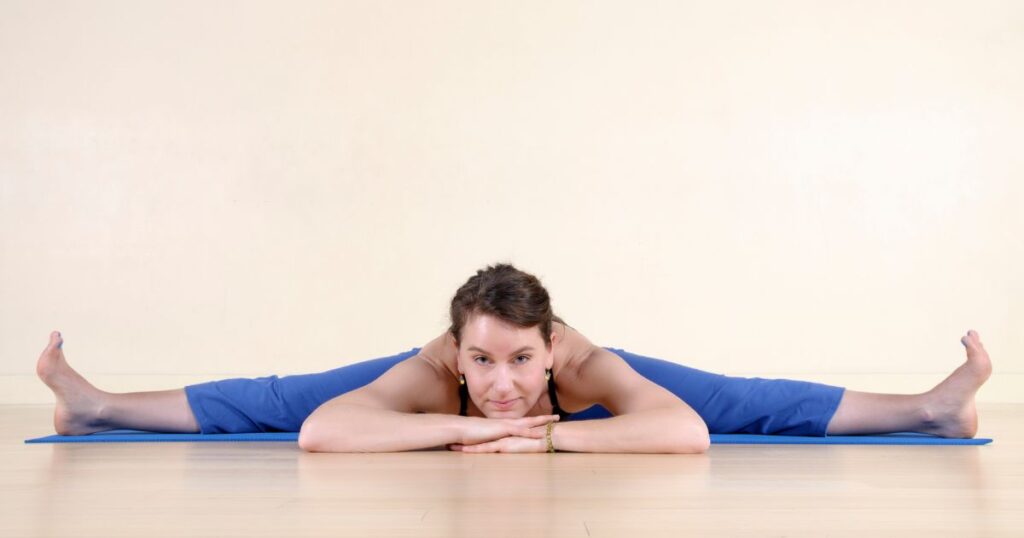
14. Take Photos To Monitor Your Progress Towards Doing The Splits
Here are some tips for taking photos of your splits progress:
Use a mirror. You can also use a friend to take a photo, but it’s easier to see what you’re doing when you use a mirror.
Take multiple shots from different angles so that you can see the whole picture.
Make sure that the camera is in focus and clear of any other objects that would get in the way of seeing what you’re doing well.
When taking photos of your splits, make sure that you’re not just stretching one leg at a time. Both legs should be stretched out to their full length and straightened out as much as possible for maximum benefit from this exercise.
15. Practice Meditation During Your Stretches
Many people find that meditation helps them feel calmer and more focused, which is handy when you’re holding a long stretch.
Meditation has a history that goes back thousands of years, and some types involve keeping your focus on one sensation, such as your breathing. Researchers have studied whether it can help people manage stress, anxiety and pain, and it may help people improve their quality of life, although the research is still developing.10
When you’re stretching, it’s easy to get distracted by the strong sensations in your muscles or by the sound of other people in the room. Slow, steady breathing can help you stay focused and relaxed as you stretch. Just don’t use it to tune out pain: a stretch should feel like tension, and pain is a sign to ease off.1
If you’re new to meditation, it may seem difficult at first, but there are plenty of resources available online that can help guide you through the process.
There are also apps like Headspace that offer guided meditations you can follow at home.
See Also: How to look after your mind, body and spirit during the winter
16. Perform Daily Affirmations About Your Flexibility And Strength
Manifest yourself doing the splits.
You can use these affirmations to help you develop your flexibility and strength.
I am flexible and strong.
My body is like a rubber band, bending and stretching to accommodate my creative movements.
My muscles are strong and firm, supporting my joints so that they don’t get injured or hurt.
I have good balance and coordination, which helps me do everything I want to do without straining myself.
My joints are healthy and strong, so they don’t get injured easily when I move them in new ways or try something new that might be difficult for me at first, but will eventually become second nature for me over time as long as I practice it regularly until it becomes habitual and automatic.
Keep repeating your affirmations. Say them out loud if you can and feel the energy that radiates from you.
17. Believe In Yourself
Finally, if you want to be able to achieve the splits faster, you have to believe in yourself.
You can’t think about how hard it will be or how long it may take you. You need to think positively and focus on your goals.
You can do it! The splits is a very challenging pose. It requires flexibility and strength in your hips, legs and core. It needs dedication to your training.
But if you have the desire to achieve it, you can do it!
Get 10% off Aerial Yoga Clothing & Equipment with Uplift Active

Use the discount code POLEFIT10 at the checkout
Sources
- Harvard Health Publishing, “The importance of stretching”, 2024. ↩︎
- Harvard Health Publishing, “Exercise 101: Don’t skip the warm-up or cool-down”, 2020. ↩︎
- Garber CE, Blissmer B, Deschenes MR and others (American College of Sports Medicine), “Quantity and quality of exercise for developing and maintaining cardiorespiratory, musculoskeletal, and neuromotor fitness in apparently healthy adults: guidance for prescribing exercise”, Medicine & Science in Sports & Exercise, 2011. ↩︎
- Cleveland Clinic, “Lactic Acid”, 2022. ↩︎
- Cleveland Clinic, “Delayed Onset Muscle Soreness (DOMS)”, 2025. ↩︎
- Herbert RD, de Noronha M and Kamper SJ, “Stretching to prevent or reduce muscle soreness after exercise”, Cochrane Database of Systematic Reviews, 2011. ↩︎
- Oranchuk DJ, Flattery MR and Robinson TL, “Superficial heat administration and foam rolling increase hamstring flexibility acutely; with amplifying effects”, Physical Therapy in Sport, 2019. ↩︎
- Sawyer PC, Uhl TL, Mattacola CG and others, “Effects of moist heat on hamstring flexibility and muscle temperature”, Journal of Strength and Conditioning Research, 2003. ↩︎
- NHS, “Joint hypermobility syndrome”, 2023. ↩︎
- National Center for Complementary and Integrative Health (NCCIH), “Meditation and Mindfulness: Effectiveness and Safety”, 2022. ↩︎