I teach both kinds of yoga, often to the same people. Someone books an aerial class because the photos look amazing, and a few weeks later asks whether they should be doing “normal” yoga too. Or a mat regular wonders if the hammock is just a gimmick.
I’ve practiced aerial yoga since 2008 and have been a qualified yoga teacher since 2013, so I’ve seen both from the student’s side and the teacher’s. Here’s how the two really differ, what the research does and doesn’t say, and who I’d send to the mat first.
What’s the difference between aerial yoga and regular yoga?
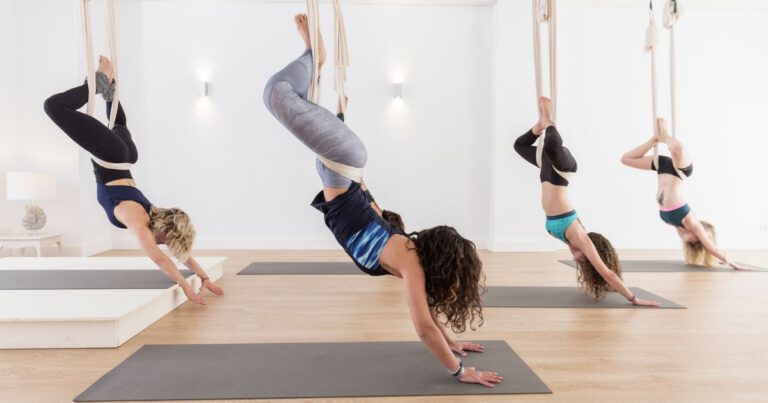
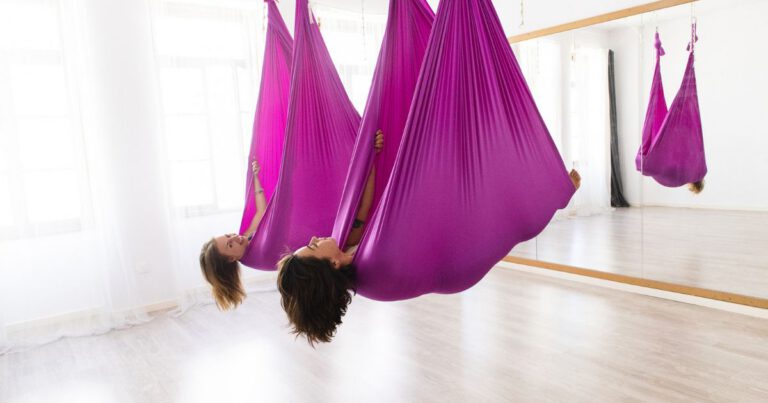
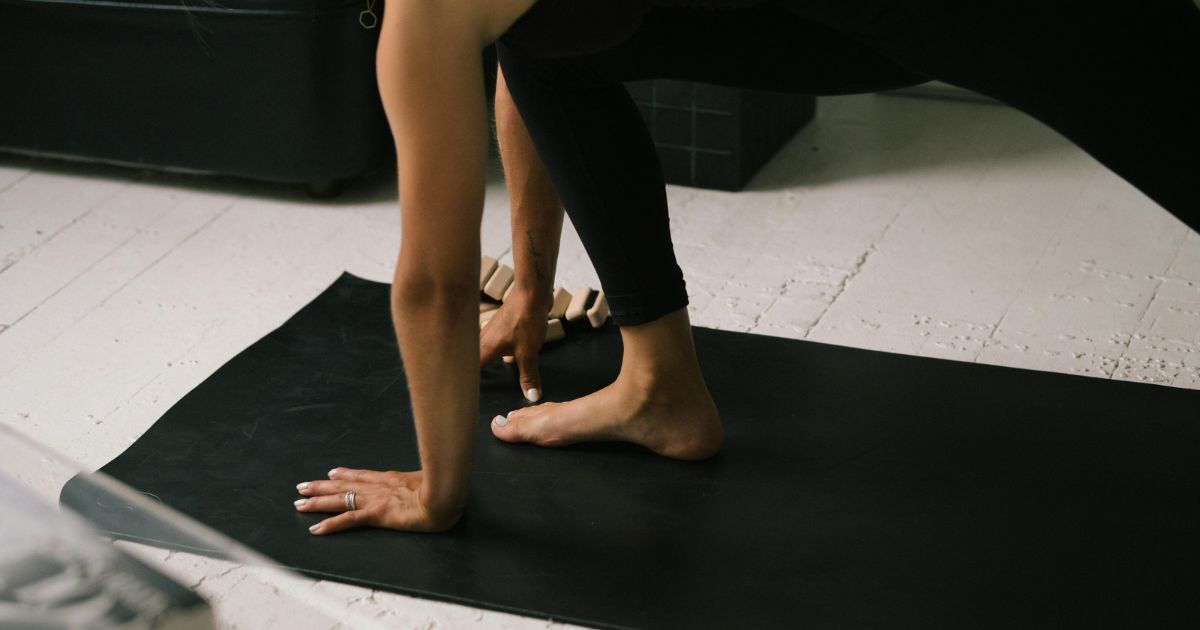
Regular yoga happens on a mat, with the floor and your own body for support. Aerial yoga adds a soft fabric hammock hung from the ceiling or a frame, which can hold part or all of your weight. That support makes some stretches and inversions easier to reach, but it also brings in equipment, rigging and grip strength.
Aerial yoga vs. regular yoga at a glance
By “regular yoga” I mean the mat classes most people know, from gentle hatha to flowing vinyasa. Styles vary a lot within each, so treat this as the typical picture.
| Aerial yoga | Regular (mat) yoga | |
|---|---|---|
| Equipment | A hammock made for aerial use, load-rated hardware, and a joist, beam or freestanding frame to hang it from | A mat. Blocks and a strap are useful but optional |
| Cost to start | Higher. Studios need rigging, and a home set-up means a hammock plus hardware or a stand | Low. Classes are easy to find, and you can start at home with just a mat |
| Strength demands | Grip, arms and core to get in and out of the hammock, although the fabric takes weight off in many poses | Your own body weight through your hands and feet, building strength in poses like plank and downward dog |
| Flexibility | The fabric supports you, so many stretches feel more accessible | You work with gravity and the floor, using props to meet you where you are |
| Safety | Adds height, inversions and rigging. Learn with a teacher and check the set-up every time | Generally low risk when taught well |
| Who it suits | Active people who want variety, supported inversions and a playful challenge, with no reason to avoid going upside down | Almost everyone, including complete beginners and anyone who needs a gentle, adaptable practice |
| Where to learn | A specialist aerial studio or a gym with rigging, then at home once you know the basics | Studios, gyms, community centers and online classes |
How does the hammock change your practice?
Think of the hammock as a prop, like a block or a strap. The difference is that it moves, and it can carry your whole body.
It supports you
In a standing split or a backbend, the fabric holds part of your weight. You can stay longer and breathe into the stretch instead of fighting for balance. Students who’ve never folded forward with straight legs on the mat often relax into it in the hammock.
It lets you go upside down without standing on your head
Supported inversions are the big draw. With the fabric around your hips, you can hang upside down with no weight on your head or neck. Compare that with a mat headstand, where one study found people put 40 to 48% of their body weight through their head.1 If inversions are what tempt you, our guide to the benefits of inversion yoga separates the evidence from the hype.
It moves
On a mat, the floor stays put. In the air, the fabric sways, and a small change in hammock height changes the whole pose. That instability is part of the fun. It’s also why aerial asks more of your grip, coordination and core.
It adds kit you have to trust
Nothing on a mat can fall down. Aerial yoga depends on a hammock, carabiners, straps and a fixing point that can all take moving loads. I’ve put up, taken down and safety-checked aerial frames for years, and I still check every connection before anyone climbs in. Our aerial rigging guide and our explainer on aerial yoga weight limits cover what to look for.
Which is the better workout?
Neither wins outright, and no study has put them head to head.
The best aerial-specific research is a small study for the American Council on Exercise (ACE). Sixteen healthy, active women aged 18 to 45 took three 50-minute aerial yoga classes a week for six weeks. The researchers classed the classes as moderate-intensity exercise, burning an average of 320 calories each.2 By the end, the group had improved their weight, body-fat percentage, waist size, aerobic fitness (VO2max), systolic blood pressure and HDL cholesterol.2
That’s encouraging, but it was a small group of women, with no mat-yoga group for comparison. It shows aerial yoga counts as real exercise. It doesn’t show that it beats a mat class.
Mat yoga has a much bigger body of research. The National Center for Complementary and Integrative Health (NCCIH) says studies of yoga have found benefits for stress and balance, better sleep in several groups of people, and a slight benefit for low-back pain.3 Most of that research is on mat yoga, so it’s the safer bet if you want a practice with a proven track record. For what aerial adds on top, see our guide to the health benefits of aerial yoga.
Strength is where the two feel most different. Mat yoga loads your wrists and shoulders in poses like plank and downward dog. Aerial asks for grip and pulling strength to climb in, lift yourself and hold on, and most new students find that harder than they expect.
Which is better for flexibility?
Flexibility is aerial yoga’s clearest research result so far. In a 2025 study of 36 sedentary women over eight weeks, researchers found that aerial yoga mainly improved flexibility, while reformer Pilates did more for core stability and postural control.4
That matches what I see in class. When the fabric holds you, you stop gripping with the muscles you’re trying to stretch, and they let go. Mat yoga builds flexibility too. It just asks you to hold yourself up while you do it, and you can practice it anywhere. Our 20-minute aerial stretch routine is a good place to feel the difference, and why flexibility matters explains the bigger picture.
Is aerial yoga riskier than mat yoga?
It has more ways to go wrong, but most of them are in your control.
Yoga in general is low risk. NCCIH says the most common yoga injuries are sprains and strains, and serious injuries are rare. It also advises learning from a qualified instructor, because practicing on your own without supervision has been linked to more injuries.3 That advice matters even more in the air.
Aerial adds three things to think about:
- Inversions. Going upside down raises the pressure in your head. Cleveland Clinic lists high or low blood pressure, heart disease, glaucoma and other eye diseases, and pregnancy among the conditions to discuss with your doctor before inverting.5 One study of head-down yoga poses found a rapid rise in eye pressure in people with and without glaucoma.6
- Height and falls. For most beginner poses the hammock hangs around hip height, so you’re never far from the floor. The risk comes from letting go before you’ve been taught how to come out of a pose.
- Rigging. A hammock is only as safe as the weakest thing holding it up. In a good studio, someone qualified has rigged and checked it. At home, that job is yours.
Our full guide to whether aerial yoga is safe goes through each risk and how to manage it.
Who should start with mat yoga first?
I’m happy to teach complete beginners in the hammock. But for some people, I’d suggest starting on the mat, or at least doing both side by side for a while.
- You’re new to exercise as well as yoga. A mat class teaches you the basic shapes, how to breathe through effort and how to listen to your body, before you add fabric and height.
- You have a condition that affects inversions. That includes high or low blood pressure, heart disease and glaucoma. NCCIH also lists knee or hip injuries, lumbar spine disease and balance problems among the conditions that may need yoga to be modified.3 Talk to your doctor first. Mat yoga is much easier to adapt.
- You’re pregnant. ACOG advises avoiding activities that could lead to a fall during pregnancy.7 If you’ve never done aerial yoga, this isn’t the time to start.
- You have a sore shoulder, wrist or back. Gripping and hanging load all three. Let it settle first.
- You get dizzy or motion sick easily. Swinging and spinning can set it off. Mat yoga lets you build up to inversions slowly.
- You want a daily home practice on a small budget. A mat costs little, fits anywhere and needs no rigging.
If you’re reasonably active, have none of those red flags and want to try something new, go straight to a beginner aerial class. Our tips for choosing an aerial yoga class will help you find a good one.
What mat yogis get wrong in their first aerial class
Experienced mat students sometimes struggle more than complete beginners in their first aerial class. These are the habits I see most often.
- Muscling through. They pull hard with their arms instead of letting the fabric take their weight. In aerial, the less you grip, the more the hammock can do for you.
- Looking for familiar alignment cues. Where the fabric sits, at the hip crease, the lower back or under the arms, matters more than where your feet are. Listen for those cues first.
- Rushing the inversion. Flexible students drop back fast because they can. Wait until you’ve been shown how to come out, and come up slowly.
- Dressing for the mat. Shorts and strappy tops let the fabric rub your skin. Cover your armpits and the backs of your knees. Our guides to what to wear for aerial yoga and preventing friction burns explain why.
It works the other way too. Students who learned in the hammock often find mat balances harder at first, because nothing is holding them up. That’s a good reason to do both.
Can you do both?
Yes, and I think most people get the most out of doing both. The mat gives you balance, body awareness and a practice you can do anywhere. The hammock adds support, supported inversions and a lot of play. A week with one aerial class and one or two mat sessions works well for many of my students.
If you’d like to practice in the air at home, start with our guide to aerial yoga equipment, then try our essential aerial yoga poses or yoga swing poses for beginners. And if you love both enough to want to teach them, here’s how to become an aerial yoga instructor.
Questions people ask about aerial and regular yoga
Is aerial yoga harder than regular yoga?
Some parts are harder and some are easier. Getting into the hammock and holding on takes grip and upper-body strength that mat yoga doesn’t ask for. But the fabric also supports you, so deep stretches and inversions can feel easier than on the floor. Most beginners find the first few classes tiring in their hands and forearms.
Do you need yoga experience to try aerial yoga?
No. A good beginner aerial class starts from scratch and teaches you how to use the hammock safely. Some mat experience helps, because you’ll know the basic poses and how to breathe through them. If you’re new to exercise too, or have any condition that affects going upside down, a few mat classes first is a sensible start.
Does aerial yoga burn more calories than regular yoga?
There’s no study comparing the two directly. In the ACE study, a 50-minute aerial class burned an average of 320 calories and counted as moderate-intensity exercise.2 A mat class could burn more or less, depending on its style and pace and on your own body. Choose the one you’ll keep doing.
Can you do aerial yoga at home?
Yes, once you’ve learned the basics with a teacher. You’ll need a hammock, load-rated hardware, and a sound joist, beam or freestanding stand to hang it from. Our step-by-step guide to installing an aerial yoga hammock at home walks you through it.
Sources
- Hector R and Jensen JL, “Sirsasana (headstand) technique alters head/neck loading: Considerations for safety”, Journal of Bodywork and Movement Therapies, 2015. ↩︎
- Lance C. Dalleck and Daniel J. Green, “ACE-Sponsored Research: Can Aerial Yoga Take Your Workouts to Another Level?”, American Council on Exercise (ACE) ProSource, January 2016. A study of 16 healthy women aged 18–45 taking three 50-minute classes a week for six weeks. ↩︎
- National Center for Complementary and Integrative Health (NCCIH), “Yoga: Effectiveness and Safety”. This covers yoga in general, not aerial yoga. ↩︎
- Demirli A, et al., “Effects of Aerial Yoga and Reformer Pilates on Core Stabilization, Flexibility and Balance: A Comparison on Sedentary Women”, Journal of Sports and Science, 2025. A study of 36 sedentary women over eight weeks. ↩︎
- Cleveland Clinic, “Inversion Tables Might Flip the Script on Back Pain”, 2025. ↩︎
- Jasien JV, et al., “Intraocular Pressure Rise in Subjects with and without Glaucoma during Four Common Yoga Positions”, PLoS One, 2015. ↩︎
- American College of Obstetricians and Gynecologists (ACOG), “Exercise During Pregnancy”, September 2024. ↩︎
Get Aerial Yoga Tips Sent Directly to Your Inbox
Join our mailing list to be the first to know about the latest aerial yoga news and products. We only include the best content in our newsletter, which includes marketing material. Read our Privacy Policy